Sometimes I’d notice it halfway through an appointment.
I’d be focused on what I was doing when I’d start to feel that familiar tension between my shoulder blades. My arms would begin to feel heavy from holding them up, and my neck would remind me how long I’d been leaning forward.
A small signal from my body that the day was starting to add up.
So I’d finish the patient and move on to the next one.
By the end of the day, though, the soreness was always more noticeable.
Your neck and shoulders feel heavy. Your upper back tightens up. Your hands and forearms carry that deep, tired feeling that lingers even after you’ve left the office.
Many dental hygienists feel sore after work, even when they’re trying to position themselves well.
After enough days like that, a question starts to come up: why do dental hygienists feel so sore after work?
It’s Not Just “A Long Day”
It’s easy to brush it off as part of the job. A long day. A busy schedule.
But that sore, heavy feeling has a reason behind it.
Your body is responding to the very specific physical demands that come with working on patients all day.
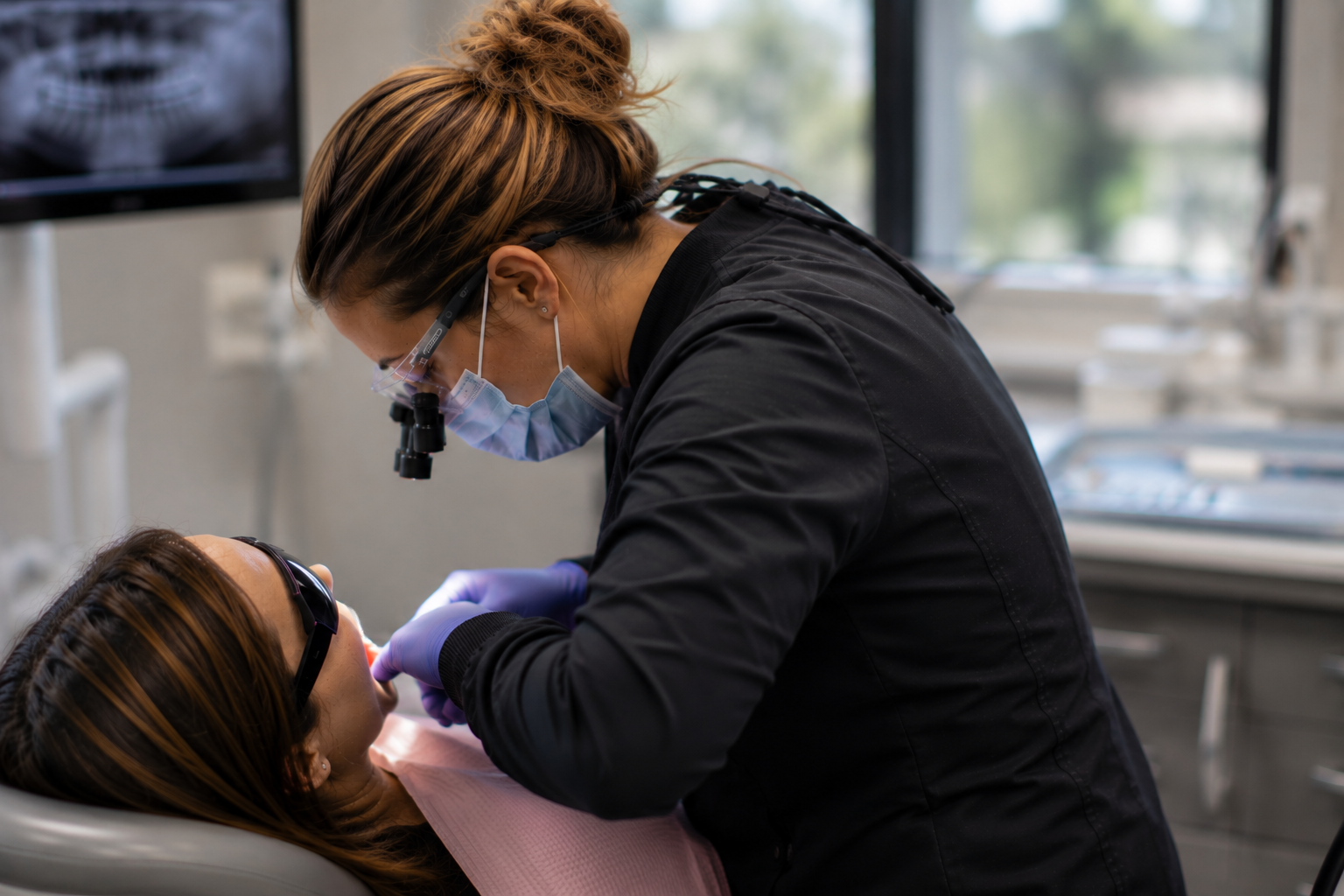
We spend hours holding our arms up, leaning forward, stabilizing instruments, and repeating the same small movements again and again.
Over time, those patterns start to add up.
Repetition Adds Up Quickly
Think about how many times a hygienist scales, adjusts a mirror, repositions a wrist, reaches, retracts, and stabilizes during a single appointment.
Now multiply that across an entire day.
Those movements repeat constantly, often with only small variations, for hours at a time.
Even small motions, when repeated often enough, begin to accumulate stress in the body.
That repetitive load tends to show up most in areas like the neck, shoulders, upper back, and forearms.
If wrist discomfort is something you’re dealing with too, you might find this helpful:
👉 Wrist Pain in Dental Hygienists: Why It Happens (And What Actually Helps)
You’re Holding More Than You Realize
Dental hygiene requires the body to stay in certain positions for longer than it naturally would.
Your arms remain slightly lifted while you work. Your attention stays fixed on a small space. Your body maintains a posture that doesn’t change very often.
That low-level effort doesn’t feel like much in the moment.
Over the course of a full clinical day, those sustained positions place steady demand on the muscles that support your neck, shoulders, and upper back while working on patients.
Repetition and Holding Positions Aren’t the Whole Story
There’s another layer to this that often gets overlooked.
Working on patients keeps your attention dialed in for hours at a time. You’re focusing on fine details, thinking clinically, communicating with patients, and keeping track of instruments and positioning all at once.
Your system stays engaged for most of the day.
So when you finally sit down at the end of the day, your body doesn’t always shift gears right away. That wired-but-tired feeling many hygienists describe can be part of the picture, too.
Why It Can Feel Worse Over Time
At first, it may simply feel like end-of-day fatigue.
But when the same physical patterns repeat day after day without enough recovery or variation, the load begins to build.
You might start noticing the soreness earlier in the day. It may feel stronger than it used to, or show up in additional areas.
Your body is responding to the demands of the work you do every day.
Why Rest Alone Doesn’t Always Fix It
You’d think rest would be enough.
Sometimes it helps. But often the soreness returns the next day.
Recovery involves more than simply stopping work at the end of the day. The body also benefits from things like:
- movement in different directions
- variation from the same patterns
- support for the areas doing the most work
Without that kind of variation, the same cycle tends to repeat the next day.
What Actually Helps
What tends to help is giving your body something different from what it’s doing all day.
That might look like:
- moving your shoulders and upper back in ways they don’t move while working on patients
- giving your forearms and hands a break from constant gripping
- building more support around the areas doing the most work
Strength work and mobility exercises can make a big difference here.
If you want to explore that more, you might find these helpful:
👉 Strength Training for Dental Hygienists
👉 Spinal Flexibility for Dental Hygienists: Why It Matters for Arterial Health
The Takeaway
End-of-day soreness often reflects how much your body is doing during a clinical day, especially when the same positions and patterns repeat for hours.
Working on patients places real demands on the body.
Over time, though, you can start to change how it feels by giving your body something different from what it experiences all day.
A little more movement.
A little more support.
And more awareness of what your body is telling you. 💜
If This Sounds Familiar
If your body has been feeling like this more often lately, many hygienists experience the same thing at some point in their careers.
The physical side of the job can start to build up over time, especially when long clinical days leave very little room for recovery.
If you’ve also been feeling guilty about needing more rest, fewer days, or a different pace, I put together something that may help: